


The Risks They Never Saw Coming, and Why Both Lost Money Anyway
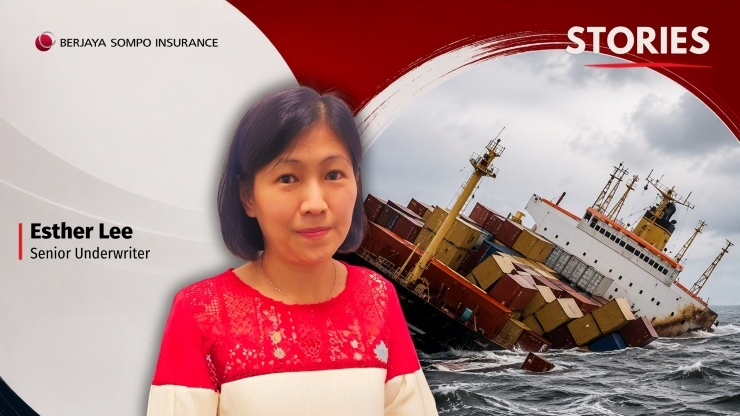
After more than two decades in marine insurance, some of the cases I remember most are not the ones involving shipwrecks, storms or spectacular cargo losses. They are the ones where everything appeared to go according to plan until it didn't.
By Esther Lee, Senior Marine Underwriter
When people think about marine cargo risks, the dangers seem obvious enough. Cargo can be damaged by rough seas, stolen in transit, dropped during loading, or arrive waterlogged after a storm. These are tangible risks that most traders instinctively understand.
What they often do not realise is that some of the most expensive losses can arise when the cargo itself is perfectly fine.
Over the years, I have encountered many claims involving damaged goods. Yet two cases have remained lodged in my memory precisely because they challenged what the customers thought they knew about risk. In both situations, the cargo owner believed he was protected. In both situations, he was wrong. And in both situations, the lesson arrived only after the vessel had already sailed.
The Container That Arrived, But Could Not Be Collected
The first case involved a customer importing a container of furniture from overseas. There was nothing particularly remarkable about the shipment. The vessel completed its voyage, the cargo arrived at port, and the furniture was intact.
From the customer's perspective, the transaction had unfolded exactly as expected.
Then he received news he never anticipated.
He could not collect his cargo.
The reason was a maritime principle known as General Average, a term that was entirely unfamiliar to him. More importantly, he had not purchased marine cargo insurance.
Like many first-time importers, he struggled to understand the problem. His furniture had not been damaged. His container had not been lost. The goods were sitting safely at the port. Why, then, was he being asked to provide money before they could be released?
The answer lies in a practice that has existed in maritime trade for centuries.
When a vessel encounters a serious emergency, extraordinary steps may sometimes be taken to save the ship, its crew and the cargo on board. Cargo may be sacrificed, emergency salvage operations may be arranged, or substantial expenses may be incurred to preserve the voyage. If those actions succeed in saving the vessel and the remaining cargo, the resulting losses and expenses may be shared among all parties who benefited from that salvation.
In other words, your own cargo does not need to be damaged for you to become financially involved.
This was the part that the customer found most surprising. He viewed the situation through a common-sense lens. His furniture survived. Someone else's cargo might have suffered a loss, but why should that involve him?
Yet General Average operates on the principle that everyone whose property was saved contributes towards the extraordinary sacrifice or expense that made that outcome possible.
Until the necessary financial security is provided, cargo may not be released.
For businesses with marine insurance, this process is often much less painful. Subject to policy terms and conditions, insurers can typically assist with the provision of the required security. In this case, however, there was no insurer standing behind the customer.
The burden fell entirely on him.

Meanwhile, another clock was ticking.
Containers left sitting at ports do not simply wait free of charge. Storage fees, detention charges and other costs can accumulate with surprising speed. What began as an unfamiliar maritime concept soon became a very real financial problem.
What struck me most was not that the customer had acted recklessly. He had not. He simply had no idea that such a risk existed.
Like many traders, he understood the danger of damage or theft. He never imagined that cargo could arrive safely and still be inaccessible.
When Transferring Risk Doesn't Remove It
Years later, I encountered a very different case that led to an unexpectedly similar outcome.
This customer was an exporter of coconut products. His shipments were sold on FOB (Free on Board) terms, one of the most commonly used arrangements in international trade.
From his perspective, the transaction was straightforward. He delivered the goods, loaded them onto the vessel, and fulfilled his contractual obligations. Under the agreed terms, the risk passed to the buyer once the goods were on board. The buyer was responsible for arranging insurance.
The exporter believed his exposure ended at the port.
Technically, he was correct.
Commercially, the situation became far more complicated.
The buyer failed to purchase the insurance that they were supposed to arrange. Somewhere during the transit process, something happened to the cargo. The details eventually mattered less than the consequence: the buyer refused to pay.
Suddenly, the exporter found himself in an uncomfortable position. He could point to the sales contract. He could argue that the risk had transferred. He could potentially pursue legal action.

But business relationships rarely exist in the neat, orderly world imagined by contracts.
A lawsuit might eventually secure a favourable judgment, but it could also consume considerable time and money while damaging an important commercial relationship. Even when a company wins the legal argument, it does not necessarily emerge as the practical winner.
In the end, the exporter suffered the loss.
What made the case particularly interesting was that there had been a solution available to him, one he had never considered because he did not realise it existed.
The solution was Seller's Interest Insurance, a form of contingency cover designed to protect a seller's financial interest when something goes wrong after the contractual risk has passed to the buyer.

The phrase "risk has passed" sounds reassuringly definitive. In reality, it often depends on the actions of other parties.
The contract may require the buyer to arrange insurance. The buyer may fully understand that obligation. Everything may appear properly documented and agreed.
But people do not always do what they are supposed to do.
When that happens, a seller can discover that transferring risk on paper does not always eliminate exposure in practice.
The Costliest Risks Are Often Invisible
These two cases were separated by years and involved entirely different circumstances. One concerned an importer whose cargo survived the voyage but remained trapped behind financial obligations he never anticipated. The other involved an exporter who had successfully transferred risk under his sales contract yet still ended up bearing the loss.
At first glance, they seem unrelated.
What links them is a common blind spot.
Neither customer was caught out by an obvious danger. They were not surprised by a storm, a collision or a theft. Instead, they were affected by risks that sat quietly in the background, unnoticed until the moment they became expensive.
Perhaps that is why I still remember them.
In marine insurance, most people focus on what might happen to the cargo. The more interesting question is sometimes what might happen around the cargo. The answer can reveal exposures that are far less visible, but no less real.
And by the time those exposures become apparent, the shipment is often already halfway across the ocean.
Esther Lee is a Senior Marine Underwriter at Berjaya Sompo with more than 20 years of experience in marine insurance.
About Berjaya Sompo Marine Insurance
As global supply chains become increasingly complex, businesses face risks that are not always visible at the point of sale or shipment. Berjaya Sompo's Marine Cargo Insurance offers protection for a broad range of cargo exposures, helping importers, exporters and traders manage the unexpected with greater confidence.
To learn more about Berjaya Sompo's Marine Insurance solutions, click Learn More below.
The marine insurance principles discussed in this article, including General Average and Seller's Interest Insurance, reflect real-world marine insurance practices. Certain narrative elements, reconstructed conversations and storytelling techniques have been incorporated to enhance readability and illustrate key concepts. Insurance coverage is always subject to the specific policy terms, conditions, exclusions and circumstances of each case.